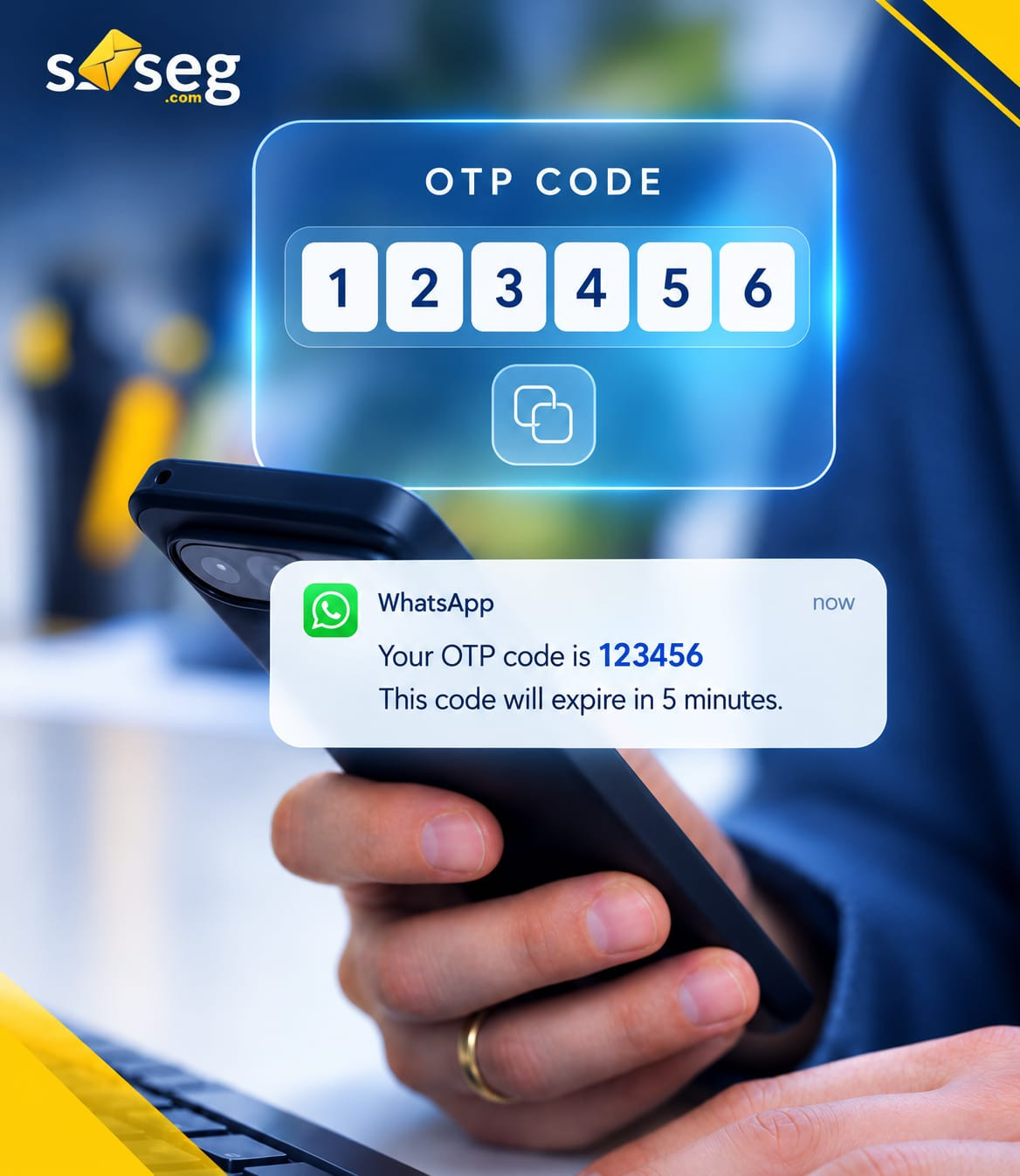
Every modern business has one thing in common: customers who need to prove who they are. They sign up, log in, pay, book, and reset passwords, and each step is a chance to either build trust or lose a sale.
That is why SMS OTP (One-Time Password by SMS) has become a core part of how companies run their digital operations. With a reliable OTP SMS service from SMSEG, you can verify customers in seconds, reduce fraud, and keep your checkout smooth. As demand for SMS marketing in Egypt, bulk SMS, and dependable smsmisr solutions grows, a strong SMS gateway is no longer a "nice to have". It is part of your business infrastructure.
This guide shows you how to plan, implement, manage, and measure SMS OTP inside your business.
Why SMS OTP Is a Business Tool, Not Just a Security Feature
Many companies see OTP as a technical detail. In reality, it affects your revenue, costs, and reputation:
Revenue: A fast code means a completed purchase. A late code means an abandoned cart.
Costs: Fake accounts and fraud cost money. Verified numbers cut that waste.
Customer data quality: Every verified phone number is a real, reachable customer for future bulk SMS campaigns.
Brand trust: A branded message with a Sender ID shows customers you are serious about their safety.
Support load: Secure self-service password reset means fewer calls to your support team.
Where to Use SMS OTP in Your Business
1. Customer registration
Confirm that every new account belongs to a real person with a working phone number.
2. Login and two-factor authentication (2FA)
Add a second layer of protection to accounts, dashboards, and admin panels.
3. Payments and checkout
Verify card payments, wallet transfers, and cash-on-delivery orders to reduce fraud and fake orders.
4. Password reset and account recovery
Let customers recover access safely without contacting support.
5. Employee and internal systems
Protect HR systems, CRMs, and company portals with OTP-based access.
6. Delivery confirmation
Ask the customer to share a code with the courier to confirm successful delivery.
7. Appointments and bookings
Verify bookings in clinics, salons, and service companies to reduce no-shows.
8. Lead verification
Confirm phone numbers on forms so your sales team only calls real, interested prospects.
Step-by-Step: How to Implement SMS OTP in Your Business
Step 1: Define where you need verification.
List every point where identity matters: sign-up, login, payment, and account changes. Not every action needs OTP, so protect the sensitive ones first.
Step 2: Choose the right SMS provider.
Look for fast delivery on all Egyptian networks (Vodafone, Orange, Etisalat, WE), a simple SMS API, delivery reports, and local support.
Step 3: Register your Sender ID.
Use your brand name instead of a random number so customers trust the message immediately.
Step 4: Integrate through the SMS API.
Connect your website, mobile app, or CRM to the OTP API. Your developers request a code, the gateway delivers it, and your system verifies it.
Step 5: Design the user experience.
Make the code field easy to see, add an auto-focus input, a clear countdown, and a "resend code" button that appears after 30 to 60 seconds.
Step 6: Write a clear OTP message.
Example: "Your [Brand] verification code is 482915. Valid for 3 minutes. Never share it with anyone."
Step 7: Set your security rules.
Choose expiry time, number of attempts, and resend limits (see the security section below).
Step 8: Test everything.
Test on different networks, devices, and times of day before launching.
Step 9: Monitor and improve.
Track delivery speed, success rate, and drop-off, then adjust.
Choosing the Right OTP Setup for Your Business Size
Small businesses and startups:
Start with a simple dashboard and a pay-as-you-go package. Use the OTP SMS API only on sign-up and checkout.
Growing e-commerce and apps:
Add 2FA for logins, delivery confirmation, and automated transactional SMS. Focus on delivery speed during sales events.
Large companies, banks, and fintech:
Require high availability, priority routing for OTP traffic, detailed reporting, and dedicated support.
OTP Security Rules Every Business Should Follow
Short expiry: 1 to 5 minutes.
One-time use: a code must never work twice.
Limited attempts: lock or delay after 3 to 5 wrong tries.
Resend limits: cap the number of codes per number per hour.
Rate limiting per IP and device: stop bots and abuse.
CAPTCHA before sending the code on public forms.
Random codes: never use predictable patterns.
Warning text: remind users not to share the code.
Encrypted storage: protect customer data on your side.
Monitor spikes: sudden jumps in OTP requests can signal an attack.
How to Control OTP Costs
OTP is cheap per message, but without limits, abuse can grow your bill. To control costs:
Limit resend requests and add timers.
Block suspicious numbers and repeated requests.
Use CAPTCHA to stop automated sign-ups.
Validate phone number format before sending.
Review delivery reports weekly.
Choose a provider with transparent pricing and flexible packages.
KPIs to Measure Your SMS OTP Performance
Delivery rate: the percentage of codes that reach the phone.
Delivery time: average seconds from request to delivery.
Verification success rate: the percentage of users who complete verification.
Resend rate: a high number means delays or confusion.
Drop-off rate: how many users leave at the OTP step.
Cost per verified user: total OTP spend divided by verified users.
Fraud and fake account rate: should go down after OTP is active.
Prepare for Peak Season: Black Friday, White Friday, and Ramadan
During big sales, thousands of customers try to log in or pay at the same moment. To be ready:
Test your OTP flow under heavy load before the event.
Make sure your provider guarantees priority delivery and high capacity.
Increase your balance early so messages never stop.
Have a support contact ready for urgent issues.
Keep a clear fallback message on your site if a code is delayed.
Common Mistakes to Avoid
Choosing the cheapest provider and ignoring delivery speed.
Making codes valid for too long.
Forgetting a resend timer, which causes spam clicks.
Not using a Sender ID, which lowers trust.
Sending OTP and promotional messages through the same route, which can slow delivery.
Skipping tests on all mobile networks.
Ignoring delivery reports.
Build a Complete Messaging Strategy with SMSEG
OTP is the start of a bigger customer communication system. With SMSEG you can manage everything in one place:
OTP SMS for secure sign-ups, logins, and payments.
Transactional SMS for orders, shipping, and payment updates.
Bulk SMS for offers, reminders, and announcements to your verified customers.
LBA SMS to reach nearby shoppers during Black Friday and seasonal sales.
SMS API to automate everything from your own system.
Frequently Asked Questions
Is SMS OTP secure enough for my business?
Yes, for most businesses. Combined with expiry, attempt limits, and rate limiting, it gives strong protection with a very easy user experience.
How fast should an OTP arrive?
Ideally within 3 to 10 seconds.
Do customers need internet to receive an OTP?
No. SMS works with just a mobile signal.
Can I use my brand name as the sender?
Yes, through an approved Sender ID.
Can I connect OTP to my website or app?
Yes, through a simple SMS API.
Can I use OTP and bulk SMS from the same account?
Yes, with SMSEG you can manage both from one platform.
Ready to Use SMS OTP in Your Business?
Don't let a late code cost you a customer. Protect your users, reduce fraud, and speed up every login and checkout with SMSEG, a leading OTP SMS service and bulk SMS gateway in Egypt.
👉 Create your account today at www.smseg.com/en/bulk-sms and launch your OTP service in minutes